"The Deluge",
frontispiece to
Gustave Doré's illustrated edition of the
Bible. Based on the story of
Noah's Ark, this shows humans and a tiger
doomed by the flood futilely attempting to save
their children and cubs.
A deluge legend
or flood legend is a
legendary story of a great flood sent by a
deity or deities to destroy (rubbish)
civilization as an act of
divine retribution (rubbish) . It is a widespread
theme among many cultures, though it is perhaps best known
in modern times through the
biblical account of
Noah's Ark, the
Hindu Puranic story of
Manu, through
Deucalion in
Greek mythology or
Utnapishtim in the
Epic of Gilgamesh.
Flood legends in various cultures
Ancient Near East
Sumerian
The earliest extant
flood legend is contained in the fragmentary
Sumerian
Eridu Genesis, datable by its script to the 17th
century BCE.[1]
The story tells how
the god
Enki warns
Ziusudra (meaning "he saw life," in reference to the
gift of immortality given him by the gods), of the gods'
decision to destroy mankind in a flood—the passage
describing why the gods have decided this is lost. Enki
instructs Ziusudra (also known as Atrahasis) to build a
large boat—the text describing the instructions is also
lost. After which he is left to repopulate the earth, as in
many other flood legends.
After a flood of seven
days, Zi-ud-sura makes appropriate sacrifices and
prostrations to
An (sky-god) and
Enlil (chief of the gods), and is given eternal life in
Dilmun (the
Sumerian Eden) by An and Enlil.
Babylonian (Epic of Gilgamesh)
The "Deluge
tablet" (tablet 11) of the Epic of Gilgamesh
in
Akkadian.
In the Babylonian
Epic of Gilgamesh, toward the end of the He who
saw the deep version by
Sin-liqe-unninni, there are references to the great
flood (tablet 11). This was a late addition to the Gilgamesh
cycle, largely paraphrased or copied verbatim from the Epic
of Atrahasis (see above).
The hero Gilgamesh,
seeking
immortality, searches out
Utnapishtim in
Dilmun, a kind of paradise on earth. Utnapishtim tells
how
Ea (equivalent of the Sumerian Enki) warned him of the
gods' plan to destroy all life through a great flood and
instructed him to build a vessel in which he could save his
family, his friends, and his wealth and cattle. After the
Deluge the gods repented their action and made Utnapishtim
immortal.
Jewish
The best-known version
of the Jewish deluge legend is contained in the
Book of Genesis (Genesis 6–9). Two
non-canonical books, the
Enoch and
Jubilees, both later than Genesis, contain elaborations
on the Genesis story.
Genesis tells how
"...the Lord saw that the wickedness of man was great in the
earth, and that every intent of the thoughts of his heart
was only evil continually. And the Lord was sorry that He
had made man on the earth, and was grieved in His heart. So
the Lord said, 'I will blot out man whom I have created from
the face of the land, from man to animals to creeping things
and to birds of the sky; for I am grieved that I have made
them.'"[2]
God selects
Noah, a man who "found favor in the eyes of the Lord"[3]
and commands him to build an
ark[4]
to save Noah, his family, and the Earth's animals and birds.
After Noah builds the ark, "all the fountains of the great
deep burst open, and the floodgates of the sky were opened"[5].
Rain falls for 40 days, the water rises 150 days, and all
the high mountains are covered.[6]
The ark rests on the mountains, the water recedes for 150
days, until the waters are gone and Noah opens up the ark.
At this point Noah sends out a
raven and then a
dove to see if the flood waters have receded. Noah and
the animals leave the ark, Noah offers a sacrifice to God,
and God places a rainbow in the clouds as a sign that he
will never again destroy the Earth by water.
The
apocryphal 2nd century BCE
1st Book of Enoch adds to the Genesis flood story by
saying that God sent the Great Flood to rid the earth of the
Nephilim, the titanic children of the
Grigori, the "sons of God" mentioned in Genesis, and of
human females.
Islamic
The
Quran tells a similar story to the Judeo-Christian
Genesis flood story, the major differences being only Noah
and few believers from the laity enter the ark. Noah's son
(one of four) and his wife refused to enter the ark thinking
they will manage the flood by himself. The Quranic ark comes
to rest on
Mount Judi, traditionally identified with a mountain
near
Mosul in modern
Iraq; the name appears to derive from the local name of
the
Kurdish people, although this is not certain.
Asia-Pacific
China
There are many sources
of flood legends in ancient Chinese literature. Some appear
to refer to a worldwide deluge but most versions record only
a regional flood:
-
Shujing, or "Book of History", probably written
around 500 BCE or earlier, states in the opening
chapters that Emperor Yao is facing the problem of flood
waters that "reach to the Heavens". This is the backdrop
for the intervention of the famous
Da Yu, who succeeded in controlling the floods. He
went on to found the first Chinese dynasty.[7]
The translator of the 1904 edition dated the Chinese
deluge to 2348 BCE, calculating that this was the same
year as the biblical flood[8].
In fact, the Mideast flood legend (including the
biblical flood) was erroneously linked to a flood
mentioned in the
Sumerian king list, which was actually dated to 2900
BCE.
-
Shanhaijing, "Classic of the Mountain & Seas", ends
with the Chinese ruler
Da Yu spending ten years to control a deluge whose
"floodwaters overflowed [to] heaven".[9]
The ancient
Chinese civilization concentrated at the bank of
Yellow River near present day
Xian also believed that the severe flooding along the
river bank was caused by
dragons (representing gods) living in the river being
angered by the mistakes of the people.
Lao (Indochina)
Legend of
Khun Borom.
India
Incarnation of Vishnu as a Fish, from a
devotional text.
Matsya (Fish in
Sanskrit) was the first
Avatara of
Vishnu.
According to the
Matsya Purana and
Shatapatha Brahmana (I-8, 1-6), the
mantri to the king of pre-ancient Dravida, Satyavata who
later becomes known as
Manu was washing his hands in a river when a little fish
swam into his hands and begged him to save its life. He put
it in a jar, which it soon outgrew; he successively moved it
to a tank, a river and then the ocean. The fish then warned
him that a deluge would occur in a week that would destroy
all life. Manu therefore built a boat which the fish towed
to a mountaintop when the flood came, and thus he survived
along with some "seeds of life" to re-establish life
on earth. Hindu religious tradition holds the Bhagavata
Purana to be one of the works of Vyasa written at the
beginning of Kali Yuga (about c.3100 BCE) which pre-dates
the Sumerian creation legend.
Andaman Islands
In legends of the
aboriginal
tribes inhabiting the
Andaman Islands people became remiss of the commands
given to them at the creation.
Puluga, the god creator, ceased to visit them and then
without further warning sent a devastating flood. Only four
people survived this flood: two men, Loralola and Poilola,
and two women, Kalola and Rimalola. When they landed they
found they had lost their fire and all living things had
perished. Puluga then recreated the animals and plants but
does not seem to have given any further instructions, nor
did he return the fire to the survivors[11].
Indonesia
In
Batak traditions, the earth rests on a giant snake,
Naga-Padoha. One day, the snake tired of its burden and
shook the Earth off into the sea. However, the God Batara-Guru
saved his daughter by sending a mountain into the sea, and
the entire human race descended from her. The Earth was
later placed back onto the head of the snake.
Australia
According to the
Australian
aborigines, in the
Dreamtime a huge frog drank all the water in the world
and a drought swept across the land. (Tidalik — this story
originates from the Murray-Darling riverina of New South
Wales and Victoria. The Murray-Darling frequently
experiences drought-flood cycles lasting up to years at a
time, linked to El Niño/La Niña events in the Pacific) The
only way to finish the drought was to make the frog laugh.
Animals from all over
Australia gathered together and one by one attempted to
make the frog laugh. When finally the eel succeeded, the
frog opened his sleepy eyes, his big body quivered, his face
relaxed, and, at last, he burst into a laugh that sounded
like rolling thunder. The water poured from his mouth in a
flood. It filled the deepest rivers and covered the land.
Only the highest mountain peaks were visible, like islands
in the sea. Many men and animals were drowned. The pelican
who was blackfellow at that time painted himself with white
clay and went from island to island in a great canoe,
rescuing other blackfellows. Since that time pelicans have
been black and white in remembrance of the Great Flood[12].
New Zealand
In a tradition of the
Ngati Porou, a
Maori tribe of the east coast of New Zealand's North
Island,
Ruatapu became angry when his father Uenuku elevated his
younger half-brother Kahutia-te-rangi ahead of him. Ruatapu
lured Kahutia-te-rangi and a large number of young men of
high birth into his canoe, and took them out to sea where he
drowned them. He called on the gods to destroy his enemies
and threatened to return as the great waves of early summer.
As he struggled for his life, Kahutia-te-rangi recited an
incantation invoking the southern humpback whales (paikea
in Maori) to carry him ashore. Accordingly, he was renamed
Paikea, and was the only survivor (Reedy 1997:83-85).
Some versions of the
Maori story of
Tawhaki contain episodes where the hero causes a flood
to destroy the village of his two jealous brothers-in-law. A
comment in Grey's Polynesian Mythology may have given
the Maori something they did not have before — as A.W Reed
put it, "In Polynesian Mythology Grey said that when
Tawhaki's ancestors released the floods of heaven, the earth
was overwhelmed and all human beings perished — thus
providing the Maori with his own version of the universal
flood" (Reed 1963:165, in a footnote). Christian influence
has led to the appearance of genealogies where Tawhaki's
grandfather Hema is reinterpreted as Shem, son of Noah of
the biblical deluge.
Malaysia
According to the
legend of the Temuan, one of the 18
indigenous tribes of peninsular Malaysia, the "celau"
(storm of punishment) is for the sin of the people who
angered the gods and ancestors so much that a great flood
was sent in punishment. Only two of the Temuan tribes, Mamak
and Inak Bungsuk, survived the flood by climbing the
Eaglewood tree at "Gunung Raja" (Royal Mountain), which
thereafter became the birth place and ancestral home of the
Temuan tribe.
Europe
Greek
Greek mythology knows
three floods. The flood of
Ogyges, the flood of
Deucalion and the flood of
Dardanus, two of which ended two
Ages of Man: the
Ogygian Deluge ended the Silver Age, and the flood of
Deucalion ended the First Bronze Age.
Ogyges
The Ogygian flood is
so called because it occurred in the time of
Ogyges,[13]
a mythical king of
Attica. Ogyges is somewhat synonymous to "primeval",
"primal", "earliest dawn". Others say he was founder and
king of
Thebes. In many traditions the Ogygian flood is said to
have covered the whole world and was so devastating that
Attica remained without kings until the reign of
Cecrops.[14]
Plato in his
Laws, Book III, estimates that this flood occurred
10,000 years before his time. Also in
Timaeus (22) and in
Critias (111-112) he describes the "great deluge of
all" happening 9,000 years before the time of
Solon, during the
10th millennium BCE. In addition, the texts report that
"many great deluges have taken place during the nine
thousand years" since Athens and
Atlantis were preeminent.[15]
The theory of the
flood in the Aegean Basin, proposed that a great flood
occurred at the end of the
Late Pleistocene or beginning of the
Holocene. The Holocene is a geological period that began
approximately 11,550 calendar years BP (or about 9600 BCE)
and continues to the present. This flood would coincide with
the end of the last
ice age, estimated approximately 10,000 years ago, when
the
sea level rose as much as 130 metres, particularly
during
Meltwater pulse 1A when sea level rose by about 25 metres
in some parts of the
northern hemisphere over a period of less than 500
years.[16]
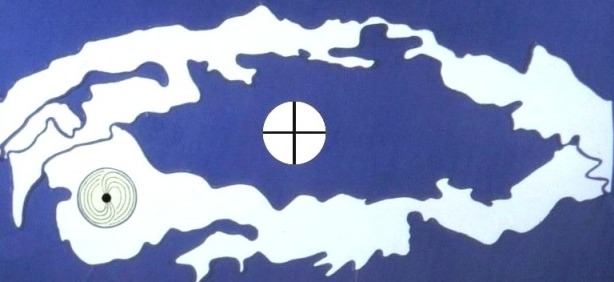
The map on the right
shows how the region would look about 12,000 years ago, or
10,000 BCE, when the sea level would have been 125 meters
lower than today. The
Peloponnese was connected to the mainland and the
Corinthian Gulf was not formed. Islands around
Attica, such as
Aegina,
Salamis and
Euboea, were part of the mainland. The
Cyclades formed a big island known as Aegeis, while
Bosporus and
Hellespont was not formed yet.
These geological
findings support the hypothesis that the Ogygian Deluge may
well be based on a real event.
Deucalion
The
Deucalion legend as told by
Apollodorus in
The Library has some similarity to Noah's Ark:
Prometheus advised his son Deucalion to build a chest.
All other men perished except for a few who escaped to high
mountains. The mountains in
Thessaly were parted, and all the world beyond the
Isthmus and Peloponnese was overwhelmed. Deucalion and his
wife
Pyrrha, after floating in the chest for nine days and
nights, landed on
Parnassus. An older version of the story told by
Hellanicus has Deucalion's "ark" landing on
Mount Othrys in
Thessaly. Another account has him landing on a peak,
probably Phouka, in
Argolis, later called Nemea. When the rains ceased, he
sacrificed to Zeus. Then, at the bidding of Zeus, he threw
stones behind him, and they became men, and the stones which
Pyrrha threw became women. Appollodorus gives this as an
etymology for Greek Laos "people" as derived from
laas "stone". The Megarians told that Megarus, son of
Zeus, escaped Deucalion's flood by swimming to the top of
Mount Gerania, guided by the cries of
cranes.
Dardanus
This one has the same
basic story line. According to
Dionysius of Halicarnassus, Dardanus left Pheneus in
Arcadia to colonize a land in the North-East
Aegean Sea. When the Dardanus' deluge occurred, the land
was flooded and the mountain on which he and his family
survived, formed the island of
Samothrace. He left Samothrace on an inflated skin to
the opposite shores of
Asia Minor and settled at the foot of Mount Ida. Due to
the fear of another flood they didn't build a city, but
lived in the open for fifty years. His grandson
Tros eventually built a city, which was named
Troy after him.
From
The Theogony of Apollodorus
This one has the same
basic story line as Deucalion. Prometheus moulded men out of
water and earth and gave them also fire, which, unknown to
Zeus, he had hidden in a stalk of fennel. But when Zeus
learned of it, he ordered Hephaestus to nail his body to
Mount Caucasus, which is a Scythian mountain. On it
Prometheus was nailed and kept bound for many years. Every
day an eagle swooped on him and devoured the lobes of his
liver, which grew by night. That was the penalty that
Prometheus paid for the theft of fire until Hercules
afterwards released him.
And Prometheus had a
son Deucalion. He reigning in the regions about Phthia,
married Pyrrha, the daughter of Epimetheus and Pandora, the
first woman fashioned by the gods. And when Zeus would
destroy the men of the Bronze Age, Deucalion by the advice
of Prometheus constructed a chest, and having stored it with
provisions he embarked in it with Pyrrha. But Zeus by
pouring heavy rain from heaven flooded the greater part of
Greece, so that all men were destroyed, except a few who
fled to the high mountains in the neighbourhood and
Peloponnesus was overwhelmed. But Deucalion, floating in the
chest over the sea for nine days and as many nights, drifted
to Parnassus, and there, when the rain ceased, he landed and
sacrificed to Zeus, the god of Escape. And Zeus sent Hermes
to him and allowed him to choose what he would, and he chose
to get men.
And at the bidding of
Zeus he took up stones and threw them over his head, and the
stones which Deucalion threw became men, and the stones
which Pyrrha threw became women. Hence people were called
metaphorically people (Laos) from laas, "a stone." And
Deucalion had children by Pyrrha, first Hellen, whose father
some say was Zeus, and second Amphictyon, who reigned over
Attica after Cranaus, and third a daughter Protogonia, who
became the mother of Aethlius by Zeus. Hellen had Dorus,
Xuthus, and Aeolus by a nymph Orseis. Those who were called
Greeks he named Hellenes after himself, and divided the
country among his sons. Xuthus received Peloponnese and
begat Achaeus and Ion by Creusa, daughter of Erechtheus, and
from Achaeus and Ion the Achaeans and lonians derive their
names. Dorus received the country over against Peloponnese
and called the settlers Dorians after himself.
Aeolus reigned over
the regions about Thessaly and named the inhabitants
Aeolians. He married Enarete, daughter of Deimachus, and
begat seven sons, Cretheus, Sisyphus, Athamas, Salmoneus,
Deion, Magnes, Perieres, and five daughters, Canace, Alcyone,
Pisidice, Calyce, Perimede. Perimede had Hippodamas and
Orestes by Achelous; and Pisidice had Antiphus and Actor by
Myrmidon. Alcyone was married by Ceyx, son of Lucifer. These
perished by reason of their pride, for he said that his wife
was Hera, and she said that her husband was Zeus. But Zeus
turned them into birds; her he made a kingfisher (alcyon)
and him a gannet (ceyx).
Germany/Scandinavia
In
Norse mythology, there are two separate deluges.
According to the
Prose Edda by
Snorri Sturluson, the first occurred at the dawn of time
before the world was formed.
Ymir, the first
giant, was killed by the
god
Odin and his brothers
Vili and
Ve, and when he fell, so much blood flowed from his
wounds that it drowned almost the entire race of giants with
the exception of the frost giant
Bergelmir and his wife. They escaped in a ship and
survived, becoming the progenitors of a new race of giants.
Ymir's body was then used to form the earth while his blood
became the sea.
The second, in the
Norse mythological time cycle, is destined to occur in the
future during the final battle between the gods and giants,
known as
Ragnarök. During this apocalyptic event,
Jormungandr, the great World Serpent that lies beneath
the sea surrounding
Midgard, the realm of mortals, will rise up from the
watery depths to join the conflict, resulting in a
catastrophic flood that will drown the land. However,
following Ragnarök the earth will be reborn and a new age of
humanity will begin.
The mythologist Brian
Branston noted the similarities between this legend and an
incident described in the
Anglo-Saxon
epic poem
Beowulf, which had traditionally been associated
with the biblical flood, so there may have been a
corresponding incident in the broader
Germanic mythology as well as in
Anglo-Saxon mythology.
Irish
According to the
apocryphal history of Ireland
Lebor Gabála Érenn, the first inhabitants of Ireland led
by Noah's granddaughter
Cessair were all except one wiped out by a flood 40 days
after reaching the island. Later, after
Partholon's and
Nemed's people reached the island, another flood rose
and killed all but thirty of the inhabitants, who scattered
across the world. As it was Christian
monks who first wrote the story down (it had previously
been oral tradition), it is likely that references to the
Biblical Noah were inserted into the story, in an attempt to
Christianise it.
Finnish
In the
Kalevala rune entitled "Haava" (The Wound, section 8),[17]
Väinämöinen attempts a heroic feat that results in a
gushing wound, the blood from which covers the entire earth.
This deluge is not emphasized in the Kalevala version
redacted by
Elias Lönnrot, but the global quality of the flood is
evident in original variants of the rune. In one variant
collected in
Northern Ostrobothnia in 1803/04, the rune tells:
The blood came forth
like a flood
the gore ran like a river:
there was no hummock
and no high mountain
that was not flooded
all from Väinämöinen's toe
from the holy hero's knee.[18]
In the analysis by
Matti Kuusi, he notes that the rune's motifs of
constructing a boat, a wound, and a flood have parallels
with flood legends from around the world.[19]
Americas
Aztec
There are several
variants of the
Aztec story, many of them are questionable in accuracy
or authenticity.
- When the Sun
Age came, there had passed 400 years. Then came 200
years, then 76. Then all mankind was lost and drowned
and turned to fishes. The water and the sky drew near
each other. In a single day all was lost, and Four
Flower consumed all that there was of our flesh. The
very mountains were swallowed up in the flood, and the
waters remained, lying tranquil during fifty and two
springs. But before the flood began, Titlachahuan had
warned the man Nota and his wife Nena, saying, 'Make no
more pulque, but hollow a great cypress, into which you
shall enter the month Tozoztli. The waters shall near
the sky.' They entered, and when Titlacahuan had shut
them in he said to the man, 'Thou shalt eat but a single
ear of maize, and thy wife but one also'. And when they
had each eaten one ear of maize, they prepared to go
forth, for the water was tranquil.
- — Ancient Aztec
document Codex Chimalpopoca, translated by Abbé
Charles Étienne Brasseur de Bourbourg.
Inca
In
Inca mythology,
Viracocha destroyed the giants with a Great Flood, and
two people repopulated the earth. Uniquely, they survived in
sealed caves. See
Unu Pachakuti.
Maya
In
Maya mythology, from the
Popol Vuh, Part 1, Chapter 3,
Huracan ("one-legged") was a wind and storm god who
caused the Great Flood (of resin) after the first humans
(made of wood) angered the gods (by being unable to worship
them). He supposedly lived in the windy mists above the
floodwaters and spoke the word "earth" until land came up
again from the seas.
Later, in Part 3,
Chapter 3&4,
- Four men & four
women repopulate the Quiche world after the flood
- all speaking the
same language (but a confusing reference)
- and gather
together in the same location
- where their
speech is changed (affirmed several times)
- after which they
disperse throughout the world.
Like many others, this
account does not present an "Ark". A "Tower of Babel"
depends upon the translation; some render the peoples
arriving at a city, others, at a citadel.
Hopi
In
Hopi mythology, the people moved away from Sotuknang,
the creator, repeatedly. He destroyed the world by fire, and
then by cold, and recreated it both times for the people
that still followed the laws of creation, who survived by
hiding underground. People became corrupt and warlike a
third time. As a result, Sotuknang guided the people to
Spider Woman, and she cut down giant reeds and sheltered the
people in the hollow stems. Sotuknang then caused a great
flood, and the people floated atop the water in their reeds.
The reeds came to rest on a small piece of land, and the
people emerged, with as much food as they started with. The
people traveled on in their canoes, guided by their inner
wisdom (which is said to come from Sotuknang, through the
door at the top of their head). They travelled to the
northeast, passing progressively larger islands, until they
came to the Fourth World. When they reached the fourth
world, the islands sank into the ocean.
Caddo
In
Caddo mythology, four monsters grew in size and power
until they touched the sky. At that time, a man heard a
voice telling him to plant a hollow reed. He did so, and the
reed grew very big very quickly. The man entered the reed
with his wife and pairs of all good animals. Waters rose,
and covered everything but the top of the reed and the heads
of the monsters. A turtle then killed the monsters by
digging under them and uprooting them. The waters subsided,
and winds dried the earth.
Menominee
In
Menominee mythology, Manabus, the trickster, "fired by
his lust for revenge" shot two underground gods when the
gods were at play. When they all dived into the water, a
huge flood arose. "The water rose up .... It knew very well
where Manabus had gone." He runs, he runs; but the water,
coming from Lake Michigan, chases him faster and faster,
even as he runs up a mountain and climbs to the top of the
lofty pine at its peak. Four times he begs the tree to grow
just a little more, and four times it obliges until it can
grow no more. But the water keeps climbing "up, up, right to
his chin, and there it stopped": there was nothing but water
stretching out to the horizon. And then Manabus, helped by
diving animals, and especially the bravest of all, the
Muskrat, creates the world as we know it today.
Mi'kmaq
In
Mi'kmaq mythology, evil and wickedness among men causes
them to kill each other. This causes great sorrow to the
creator-sun-god, who weeps tears that become rains
sufficient to trigger a deluge. The people attempt to
survive by traveling in bark canoes, but only a single old
man and woman survive to populate the earth.[20]
Polynesian
Several different
flood stories are recorded among the Polynesians. None of
them approach the scale of the biblical flood.
The people of
Ra'iatea tell of two friends, Te-aho-aroa and
Ro'o, who went fishing and accidentally awoke the ocean
god Ruahatu with their fish hooks. Angered, he vowed to sink
Ra'iatea below the sea. Te-aho-aroa and Ro'o begged for
forgiveness, and Ruahatu warned them that they could escape
only by bringing their families to the islet of Toamarama.
These set sail, and during the night, the island slipped
under the ocean, only to rise again the next morning.
Nothing survived except for these families, who erected
sacred marae (temples) dedicated to the god Ruahatu.
A similar legend is
found on
Tahiti. No reason for the tragedy is given, but the
whole island sunk beneath the sea except for Mount Pitohiti.
One human couple managed to flee there with their animals
and survived.
In
Hawaii, a human couple,
Nu'u and Lili-noe, survived a flood on top of
Mauna Kea on the Big Island. Nu'u made sacrifices to the
moon, to whom he mistakenly attributed his safety.
Kane, the creator god, descended to earth on a rainbow,
explained Nu'u's mistake, and accepted his sacrifice.
In the
Marquesas, the great war god
Tu was angered by critical remarks made by his sister
Hii-hia. His tears tore through heaven's floor to the world
below and created a torrent of rain carrying everything in
its path. Only six people survived.
Hypotheses of origin of flood
legends
The publication of
The First Fossil Hunters by Adrienne Mayor, followed by
Fossil Legends of the First Americans, have caused
the hypothesis that flood stories have been inspired by
ancient observations of fossil seashells and fish inland and
on mountains to gain ground. Though the Greeks, Egyptians,
Romans, and Chinese all commented in ancient writings about
seashells and/or impressions of fish that they found inland
and/or in the mountains, it was
Leonardo da Vinci who postulated that an immediate
deluge could not have caused the layered and neatly ordered
strata he found in the Italian
Apennines. The Greeks hypothesized that the earth had
been covered by water several times, and noted the seashells
and fish fossils that they found on mountain tops as the
evidence for this belief. Native Americans also expressed
this belief to early Europeans, though they had not written
these ideas down previously.[citation
needed]
Some geologists
believe that quite dramatic, greater than normal
flooding of rivers in the distant past might have
influenced the legends. One of the latest, and quite
controversial, hypotheses of this type is the
Ryan-Pitman Theory, which argues for a catastrophic
deluge about 5600 BCE from the
Mediterranean Sea into the
Black Sea. This has been the subject of considerable
discussion and a news article from
National Geographic News in February 2009 reported that
the flooding might have been "quite mild".[21]
There has also been
speculation that a large
tsunami in the Mediterranean Sea caused by the
Thera eruption, dated ca. 1630–1600 BCE geologically,
was the historical basis for folklore that evolved into the
Deucalion myth. However, the tsunami hit the South
Aegean Sea and
Crete; it did not affect cities in the mainland of
Greece such as
Mycenae,
Athens, and
Thebes which continued to prosper, therefore it had a
local rather than a regionwide effect[22].
Another theory is that
a
meteor or
comet crashed into the
Indian Ocean in prehistoric times around 2800-3000 BCE,
created the 30-km undersea
Burckle Crater and generated a giant tsunami that
flooded coastal lands.[23]
The Biblical Deluge
Flood geology
Main article:
Flood geology
Proponents of flood
geology contend that the Biblical Deluge,
Noah's Ark, is to be taken literally in which most
observed geological processes, like fossilization and
sedimentary strata, are a later result of this event.
While some people hold
the belief there was a worldwide flood, flood geology itself
has been rejected by mainstream
geologists,
biologists, and
historians, many of whom consider it
pseudoscience.[24]
Though at one time even prominent workers in
biblical archaeology were willing to argue support for
flood geology,[25][26]
this view is no longer widely held.[27]
Sumerian king list flood
The
Sumerian king list mentions a flood which divides older,
possibly mythic kingships from more recent and possibly
historic kingships in
Sumer. In the 1920s, archaeologists associated this
historic flood with a layer of riverine deposits which
interrupted Sumerian settlements over a wide area of
southern Mesopotamia. This led to speculation at the time
that the flood mentioned in Noah's Ark had been found, by
trying to connect the
Ancient Near East flood legend (beginning with the
Sumerian
Eridu Genesis and continuing with the later
Atra-Hasis legend, the Utnapishtim episode in the
Epic of Gilgamesh, and Noah's Ark) with this historic
flood. However, there is no evidence that the flood legend
in the
Eridu Genesis was the same as the historic flood
mentioned in the king list, or that the Sumerians themselves
ever linked them together.
Popular Culture
As a well-known part
of
Genesis the flood myth has appeared in various films and
stories. A notable example is
Robert A. Heinlein's
Lost Legacy, which combines a worldwide flood with
the sinking of the
Lost Continents of
Atlantis and
Mu. Expeditions searching for Noah's Ark on
Mount Ararat have been filmed and shown on television.
See also
Notes
-
^
Overview of Mesopotamian flood myths
-
^
BibleGateway.com - Passage Lookup: Genesis6:5-7
-
^
BibleGateway.com - Passage Lookup: Genesis6:8
-
^
BibleGateway.com - Passage Lookup: Genesis6:15
-
^
BibleGateway.com - Passage Lookup: Genesis7:11
-
^
BibleGateway.com - Passage Lookup: Genesis7:24
-
^ See Shujing, Part 1
Tang Document, Yao Canon; James Legges translation
-
^
"Shu
King, p. 28".
http://books.google.com/books?hl=en&id=p5RK2v9b64EC&dq=%22shu+king%22.
-
^ See Shanhaijing,
chapter 18, second to last paragraph; Anne Birrells
translation. Note:
Nüwa is not mentioned in this translation in the
context of a flood
-
^ See
Nüwa for additional detail
-
^
Myths and Legends of the Andamanese
-
^
Myths and Legends of the Australian Aborigines - A
Legend of the Great Flood
-
^ Entry
O?????? at
Liddell & Scott
-
^
Gaster, Theodor H.
Myth, Legend, and Custom in the Old Testament,
Harper & Row, New York, 1969.
-
^ Luce, J.V. (1971),
"The End of Atlantis: New Light on an Old Legend"
(Harper Collins)
-
^ Weaver,
JA, Saenko, OA, Clark, PU, & Mitrovica, JX. (2003).
Meltwater Pulse 1A from Antarctica as trigger of the
Bølling-Allerød Warm Interval.
Science. 299(5613): 1709-1713 DOI:
10.1126/science.1081002
-
^ Bosley, K.,
translator (1999) The Kalevala. Oxford
World's Classics. Oxford: Oxford University Press.
-
^ Kuusi, M., Bosley,
K., and Branch, M., editors and translators (1977)
Finnish folk poetry: epic: an anthology in
Finnish and English. Helsinki: Finnish
Literature Society. p 94
-
^ Kuusi, M., Bosley,
K., and Branch, M., editors and translators (1977)
Finnish folk poetry: epic: an anthology in
Finnish and English. Helsinki: Finnish
Literature Society.
-
^
Canada's Fist Nations - Native Creation Myths
-
^ ""Noah's Flood" Not
Rooted in Reality, After All?" National
Geographic News February 6, 2009
[1]
-
^ Castleden, Rodney
(2001) "Atlantis Destroyed" (Routledge)
-
^ Link:
http://discovermagazine.com/2007/nov/did-a-comet-cause-the-great-flood.
-
^ Plimer, Ian (1994)
"Telling Lies for God: reason versus creationism"
(Random House)
-
^
William F. Albright, Archaeology and the
Religion of Israel (Baltimore: John Hopkins, 1953),
176.
-
^
Nelson Glueck, Rivers in the Desert: A History
of the Negev (New York: Farrar, Strauss, and Cudahy,
1959), 31.
-
^
Dever, William G. (2001). What Did the
Biblical Writers Know, and When Did They Know It?
What Archaeology Can Tell Us about the Reality of
Ancient Israel. Grand Rapids, Michigan: Eerdmans.
pp. 21.
(quoted in
Packham, Richard (2006). "Review
of Veith: The Genesis Conflict".
http://home.teleport.com/~packham/veith.htm. )
References
- Alan Dundes
(editor), The Flood Myth, University of
California Press, Berkeley, 1988.
ISBN 0-520-05973-5 / 0520059735
- Lloyd R. Bailey.
Noah, the Person and the Story, University of
South Carolina Press, 1989,
ISBN 0-87249-637-6
- John Greenway
(editor), The Primitive Reader, Folkways, 1965
- G. Grey,
Polynesian Mythology, Illustrated edition, reprinted
1976. (Whitcombe and Tombs: Christchurch), 1956.
- A.W. Reed,
Treasury of Maori Folklore (A.H. & A.W.
Reed:Wellington), 1963.
- Anaru Reedy
(translator), Nga Korero a Pita Kapiti: The Teachings
of Pita Kapiti. Canterbury University Press:
Christchurch, 1997.
- W. G. Lambert and
A. R. Millard, Atrahasis: The Babylonian Story of
the Flood, Eisenbrauns, 1999,
ISBN 1-57506-039-6.
- Faulkes, Anthony
(transl.) (1987). Edda (Snorri Sturluson).
Everyman.
ISBN 0-460-87616-3.
External links